On point
CRIMINAL DEFENSE AI PRICING
AI for Criminal Defense Lawyers and the Best AI for Criminal Defense Attorneys by Price
What a US criminal defense firm or public defender office pays for AI in 2026, sorted by the job each tool does, with prices read from vendor pages and public county contracts.
US firms · Research tool, not legal advice
CaseSearch research console
Federal + state
|
Try:
Reading opinions
Finding the authorities that answer your question...
Sample answer. That question is outside the worked examples this preview ships with, so the authorities below show the format rather than an answer to what you typed. Pick one of the example questions above for a fully worked result.
Controlling statute
The controlling statute is surfaced alongside the case law so you read the code and the precedents together.
Plain-English answer
Research memo
- Question
- Short answer
- Authorities
CaseSearch shows you the sources. Always read the full opinion and verify citations before you rely on them.
The short answer
The best AI for criminal defense lawyers depends on which of three jobs is eating your week. Reviewing body camera footage, interrogation video and jail calls is transcription and evidence review, done by JusticeText (sold by quote, with public county contracts from 3,600 to 150,000 dollars a year) or by general tools such as Reduct from 12 dollars a month and Rev from 29.99. Summarizing preliminary hearing and deposition transcripts costs about 25 dollars a file on CaseMark. Finding the suppression, Brady and sentencing decisions that control your motion is case law research, and CaseSearch does that for 49 dollars a month, or 24 billed yearly.
3
jobs a defense practice buys AI for: video discovery, transcripts, case law
$150,000
a year, Riverside County's site-wide JusticeText license for its public defender
240
hours of audio and video per person per year under that county license
$24
a month for CaseSearch case law research, billed yearly
Side by side
Criminal defense AI tools and what each one costs
Read from each vendor's own pricing page in October 2026, or from the public county record where the vendor publishes no price. Prices are per month unless the row says otherwise.
| Tool | Job it does | Published price | How it is priced | Case law research | How to try it |
|---|---|---|---|---|---|
| JusticeText | Body camera, interrogation and jail call review: transcripts, timelines, clips and redaction | No public price. County contracts: $3,600 a year for 3 users (McLean County, IL, 2023 agenda) up to $150,000 site-wide (Riverside County, CA, 2025) | Annual license, per user or site-wide, by quote | No | Request access form, demo |
| Reduct | Video and audio transcription, search, redaction, legal-formatted transcripts | Personal $12, Professional $40, Enterprise from $75 per editor | Per editor, monthly or annual (20% off annually) | No | 14 day trial with 5 hours of AI transcription |
| Rev | AI transcription of recordings; human and legal-formatted transcripts on order | Essentials $29.99 ($25.49 annually), Pro $59.99 ($47.99 annually); human $1.99 a minute; legal transcripts $2.25 to $2.50 a page | Per seat, plus per minute or per page | No | Sign up online |
| CaseMark | Preliminary hearing, deposition and interview summaries | $25 per summary, transcription $5 an hour | Pay as you go, no subscription | No | Try one summary |
| Westlaw Edge | Full research platform, one state | $107.25, one attorney, 3 year term ($132 on 1 year) | Per firm, 1, 2 or 3 year terms | Yes, with KeyCite | 7 day Westlaw trial |
| Lexis+ Essential | Full research platform, one state | $114, 3 year term ($152 on 1 year) | Per attorney, 1 to 3 attorneys online | Yes, with Shepard's | Store purchase |
| CaseSearch | Plain-English case law research with a good-law signal | $49 a month, or $24 billed yearly | Per user, month to month or yearly | Yes, that is the whole product | One run with no account |
JusticeText figures come from public county records: the Riverside County Board of Supervisors item of August 26, 2025, a McLean County Justice Committee agenda of December 2023, a Blair County, Pennsylvania renewal of $8,000 for March 2026 to February 2027, and a Cumberland County, Pennsylvania grant-funded contract of $17,300 approved in July 2025. Contract size depends on headcount and hours, so a private firm's quote will differ. Prices change; confirm on the vendor's page before you sign. CaseSearch is a research tool, not legal advice.
What does AI do for a criminal defense lawyer?
In a defense practice, AI earns its keep in three places. The first is video and audio discovery: body camera footage from every officer on scene, dash camera video, interrogation recordings, 911 calls and jail calls. A single DUI or assault case can arrive with several hours of footage, and a homicide case with hundreds. The second is the written record: police reports, preliminary hearing and suppression hearing transcripts, witness interviews and lab reports. The third is the law: what your state's appellate courts and your federal circuit have actually held on the stop, the search, the confession or the sentence.
Most "best AI for criminal defense" lists put all three in one ranking, next to general chatbots and practice management suites, and rarely say what anything costs. That makes it easy to overspend. A solo who handles mostly misdemeanors and DUIs needs fast, searchable transcripts and a reliable way to find suppression cases. A public defender office with forty attorneys needs a site license for video review. The right question is which job costs your office the most hours, and what the cheapest tool that does that job well costs.
Video discovery
Body camera, dash camera, interrogation and jail calls.
Written record
Hearing transcripts, reports, interviews.
Case law
The search, confession and sentencing decisions that control your motion.
What is the best AI for criminal defense lawyers?
For video evidence, JusticeText is the tool built for defense work. It turns footage and calls into time-stamped, searchable transcripts in more than 100 languages, builds case timelines, flags inconsistencies across recordings and lets you clip, redact and sync video for trial exhibits. Public defender offices are its core market, and its published case studies also include private defense firms. If you only need accurate transcripts you can search and quote, general transcription tools are much cheaper: Reduct starts at 12 dollars per editor a month and its Professional plan adds redaction and legal-formatted transcripts, while Rev sells AI transcription by seat and human or legal-formatted transcripts per minute or page.
For hearing and interview transcripts, CaseMark sells summaries per file with no subscription. For the motions themselves, a research tool that returns cited decisions and shows whether each one is still good law is what keeps a suppression motion from resting on a case that was narrowed or reversed. Westlaw and Lexis+ do that with KeyCite and Shepard's on multi-year terms; CaseSearch does the research job alone, month to month.
Video review
JusticeText by quote; Reduct from $12; Rev from $29.99.
Transcript summaries
CaseMark, $25 a file.
Case law
CaseSearch, $49 a month or $24 billed yearly.
How much does criminal defense AI cost?
It ranges from about 12 dollars a month to six figures a year, and the spread is mostly the video job. JusticeText publishes no price list, but county boards publish its contracts. Riverside County, California ratified a site-wide license for its public defender in August 2025 at 150,000 dollars for the year to June 30, 2026, with three optional renewals at 165,000 dollars a year, 645,000 dollars in total, covering all staff with up to 240 hours of audio and video per person a year. At the small end, a McLean County, Illinois agenda from December 2023 put a three-user renewal at 100 dollars per user a month, 3,600 dollars for twelve months. Blair County, Pennsylvania renewed a site-wide license for 8,000 dollars for March 2026 to February 2027.
General transcription is far cheaper. Reduct lists Personal at 12 dollars per editor a month with 120 hours of transcription a year, Professional at 40 dollars with 300 hours, redaction and legal-formatted transcripts, and Enterprise from 75 dollars. Rev lists Essentials at 29.99 dollars a month (25.49 billed annually) and Pro at 59.99 (47.99 annually), human transcription at 1.99 dollars a minute and legal-formatted transcripts at 2.25 to 2.50 dollars a page. CaseMark charges 25 dollars per summary. The research line is usually the biggest fixed cost for a small firm: Westlaw Edge for one state from 107.25 dollars a month and Lexis+ Essential from 114, both on multi-year terms, against 24 to 49 dollars for CaseSearch.
Solo stack
Reduct Professional, CaseMark per file and CaseSearch, under $120 a month.
Office stack
A JusticeText site license plus a research platform.
Watch for
Hour caps on uploads, seat minimums and multi-year terms.
Can AI review body camera footage and jail calls?
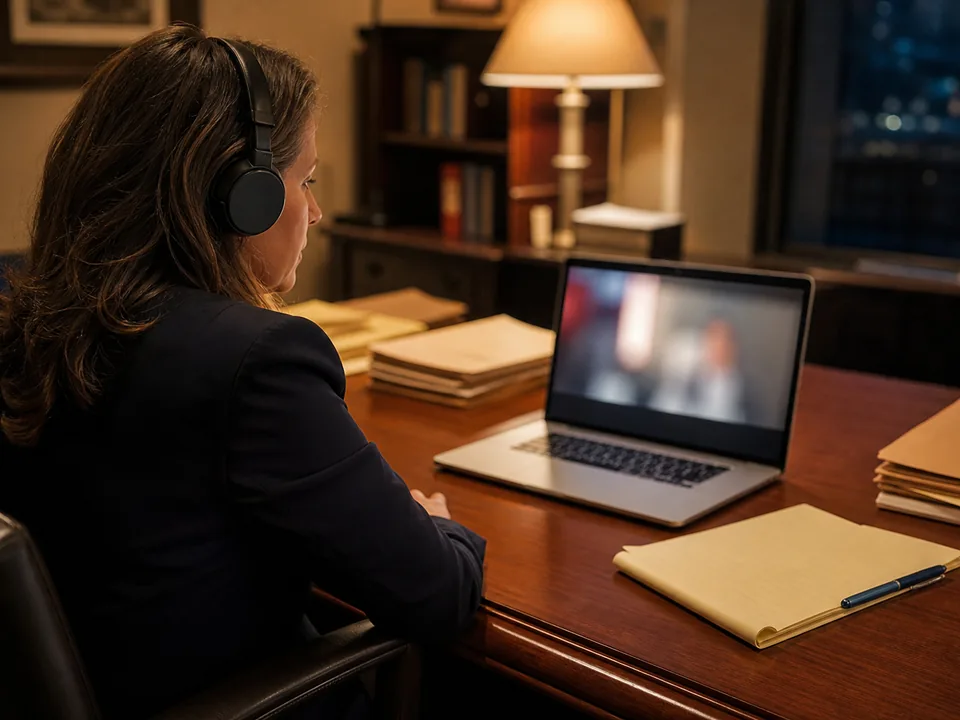
Yes, and it is the clearest time saving in defense work. The AI produces a time-stamped transcript within minutes of upload, so you can search every officer's footage for the word "consent", the Miranda warning or the moment a suspect asked for a lawyer, and jump straight to that second of video instead of watching hours end to end. Riverside County's board item describes exactly that workflow: each attorney uploads a recording, gets an AI transcript within minutes, searches it and trims the clips needed for court, partly replacing third-party transcription vendors.
Two cautions apply. Automated transcripts miss words on noisy scenes and overlapping speech, so anything you quote in a motion or play for a jury needs to be checked against the recording, and some courts expect a certified transcript. And discovery often arrives under a protective order, so read the order before uploading footage to any outside service and confirm where the vendor stores it.
Search
Find consent, Miranda and invocation moments by keyword.
Verify
Check every quoted line against the recording.
Check the order
Protective orders can limit where discovery is uploaded.
Which criminal defense AI tools do case law research?

Few of them. JusticeText, Reduct, Rev and CaseMark do not search case law at all; they work on the evidence and the record. Westlaw and Lexis+ do research thoroughly, with KeyCite and Shepard's, and both now bundle generative AI assistants, but entry plans start above 100 dollars a month for a single state and the online prices assume a one to three year term. General chatbots will answer a legal question, but they have produced invented citations that courts have sanctioned lawyers for filing, so every case they name has to be pulled and read.
Defense research is narrower than it looks and moves fast. Whether a warrantless search of a phone survives depends on Riley v. California (2014) and on how your circuit has applied it since; whether historical cell-site location data needed a warrant depends on Carpenter v. United States (2018) and the cases sorting out what it covers. A plain-English research tool lets you ask the question the way you would put it to a colleague, for example whether your state's courts have suppressed evidence where officers extended a traffic stop to wait for a drug dog, and read the controlling decisions.
No research
JusticeText, Reduct, Rev, CaseMark.
Research included
Westlaw, Lexis+, on multi-year terms.
Research only
CaseSearch, month to month.
Is AI safe for confidential criminal defense files?
It can be, if you check a few things before uploading anything. Defense files hold privileged communications, a client's own statements, medical and mental health records and discovery that is often under a protective order. Ask each vendor whether your data trains its models, where it is stored, who at the vendor can see it, and whether it will sign a data processing agreement. The ABA's Formal Opinion 512, issued in July 2024, says lawyers using generative AI must understand the tool well enough to protect client confidentiality, may need informed client consent before entering confidential information into some tools, and must review the output.
A practical split many defense lawyers use: evidence tools get the discovery because that is their job and the contract covers it, research tools get the legal question without the client's name or facts that identify the case, and nothing generated goes to the court without a lawyer reading every citation. A question such as whether an anonymous tip alone justified a stop in your state needs no client identifiers at all.
Ask
Does my data train the model, and where is it stored?
Strip
Names and identifying facts from research questions.
Review
Every citation before filing.
Where CaseSearch fits in a criminal defense practice
CaseSearch does the research job and nothing else. Ask in plain English, for example whether Texas courts have held that the smell of marijuana alone no longer gives probable cause to search a car after hemp was legalized, and you get the on-point decisions with citations, the holding in plain language and a signal showing whether each one is still good law. That is the research behind a motion to suppress, a Brady motion, a response to a motion in limine or a sentencing memo arguing for a variance.
It does not transcribe footage, summarize hearings or manage your caseload, and it is not legal advice. It costs 49 dollars a month, or 24 a month billed yearly, with no sales call and no multi-year term, and one real question at the top of this page runs without an account. Paired with a transcription plan and per-file summaries, it gives a solo or small defense firm the whole stack for less than one entry-level research platform seat.
Does
Controlling cases, holdings, good-law signal.
Does not
Video transcription, summaries or case management.
Costs
$49 a month, or $24 billed yearly.
Frequently asked
Questions criminal defense attorneys ask about AI
What is the best AI for criminal defense lawyers?
It depends on the job. For body camera and jail call review, JusticeText is built for defense work and sold by quote; Reduct (from 12 dollars a month) and Rev (from 29.99) are cheaper transcription options. For hearing transcript summaries, CaseMark charges 25 dollars a file. For the case law behind a motion, CaseSearch costs 24 to 49 dollars a month.
Can criminal defense lawyers use AI?
Yes. Defense lawyers use AI to transcribe and search body camera footage and jail calls, summarize hearing transcripts, draft first versions of motions and research suppression, Brady and sentencing case law. The lawyer stays responsible for confidentiality, for any protective order on the discovery and for reading every citation before filing.
How much does JusticeText cost?
JusticeText publishes no price list. Public county records show the range: a McLean County, Illinois agenda put three users at 100 dollars each a month (3,600 a year) in 2023, Blair County, Pennsylvania renewed a site license for 8,000 dollars for 2026 to 2027, and Riverside County, California pays 150,000 dollars a year for a site-wide license.
Can ChatGPT be used for criminal defense?
For brainstorming, outlines and plain-language explanations, yes, on a business plan that does not train on your data. Do not paste a client's identifying facts or protected discovery into a consumer account, and never file a case it names without pulling and reading it, because chatbots invent citations.
Is there AI software for public defenders?
Yes. JusticeText was built for public defender offices and is licensed per user or site-wide by counties and state defender agencies, often paid from indigent defense grants. Offices also use general transcription tools, transcript summary services and research platforms, usually through a county or state contract.
Will AI replace criminal defense attorneys?
No. AI shortens discovery review and first drafts, but it cannot advise a client on a plea, cross-examine an officer, argue a suppression motion or take responsibility for a client's liberty. What it changes is how many hours of footage and transcripts one lawyer can get through before trial.
Keep reading
AI for estate planning attorneys
Drafting, probate and research tools priced for trusts and estates firms.
JusticeText pricing
What counties pay for JusticeText, per user and site-wide.
AI for immigration lawyers
Visalaw.ai, Docketwise and AILALink priced for immigration firms.
AI for litigators
Litigation AI priced by job, from research to judge analytics.
AI for family law
Family law AI priced by job, from support math to research.
AI for personal injury lawyers
EvenUp, Supio and Eve pricing for plaintiff firms.
Legal citation checker
Check whether every case in a motion is still good law.
Westlaw pricing
Every online Westlaw plan, priced for 1 to 10 attorneys.
LexisNexis pricing
Lexis+ store prices by plan and term.
Legal AI free trial
Which legal AI tools you can try without a sales call.
CaseSearch pricing
Our own published price, with no sales call.
CaseSearch is a legal research tool, not legal advice. Always read the full opinion and verify citations before relying on them.
Start now
Find the suppression and sentencing cases behind your next motion
Ask your criminal law question in plain English and read the on-point decisions, their citations and a good-law signal. One run needs no account. After that, 49 dollars a month or 24 billed yearly, cancel anytime. A research tool, not legal advice.